Views: 0 Author: Site Editor Publish Time: 2026-07-13 Origin: Site
Industrial maintenance is moving rapidly away from abrasive blasting and chemical solvents. Facilities now embrace non-contact laser ablation for surface preparation. This shift eliminates secondary waste and protects valuable base materials. Traditional water-cooled systems offer massive power but bring significant drawbacks. They restrict mobility heavily on the factory floor. They require bulky chiller units and demand constant fluid maintenance. These limitations often make them unsuitable for confined spaces or remote factory zones.
You will learn how air-cooled alternatives solve these mobility challenges while delivering consistent power. We will explore thermal management, duty cycles, and proper power-matching strategies. This guide helps you choose the right equipment to ensure operational success. Proper knowledge prevents costly equipment mismatch and safeguards your daily production schedules. You can deploy these modern systems safely across diverse environments.
Mobility vs. Sustained Output: Air-cooled systems eliminate bulky chillers, offering true handheld portability, but face thermal limitations during continuous, high-wattage operation in extreme ambient temperatures.
Substrate Protection: When paired with pulsed laser technology, air-cooled machines can effectively strip rust, paint, and oxides without altering the underlying base metal.
TCO Reduction: Eliminating water pumps, antifreeze, and fluid maintenance significantly lowers the Total Cost of Ownership (TCO) compared to traditional cooling methods.
Power Alignment: Precision tasks thrive on a 200W baseline, while heavy-duty industrial scaling requires rigorous validation of an OEM's thermal dissipation engineering.
Traditional abrasive methods incur high consumable expenses. Sandblasting creates immense dust and requires extensive cleanup. Chemical solvents introduce hazardous waste disposal fees. Water-cooled lasers solve these waste problems effectively. However, they force operators to manage restrictive umbilicals. They also require strict preventative maintenance schedules for fluid chillers. You must constantly monitor water purity and prevent freezing in winter conditions.
Your success criteria rely on balancing speed and agility. You need high ablation rates measured in square feet per hour. You also need unparalleled deployment flexibility. Operators must easily move equipment across scaffolding, narrow walkways, and confined spaces. Heavy water chillers make this agility impossible in real-world scenarios. Agile equipment keeps your maintenance teams moving swiftly between jobs.
Core applications highlight this demand for portable solutions. Use these highly mobile systems for pre-weld surface preparation. They seamlessly handle post-weld discoloration removal directly on the fabrication floor. They also excel at NDT (Non-Destructive Testing) prep. Furthermore, they clean complex injection molds perfectly. They remove stubborn manufacturing residues without causing thermal distortion to expensive tooling. Industrial laser cleaning relies on this adaptability to streamline factory workflows.
Financial efficiency improves dramatically when you adopt mobile solutions. You eliminate recurring purchases of abrasive media. You avoid paying hazardous material disposal teams. Facilities achieve rapid returns simply by streamlining their daily preparation workflows. Maintenance teams spend less time preparing tools and more time actually restoring valuable assets.
A modern air-cooling laser cleaner uses advanced engineering to prevent overheating. It relies on massive aluminum or copper heat sinks. These sinks draw intense heat away from the sensitive internal laser diodes. High-CFM (cubic feet per minute) industrial fans force ambient air across these cooling fins. Intelligent software actively throttles electrical output to manage sudden temperature spikes. You do not need any liquid cooling mediums.
Air-cooling perfectly matches pulsed laser technology. Short, high-peak-power bursts create micro-plasma expansions on the material surface. These rapid expansions eject contaminants instantly. The pulsed emission introduces very little continuous heat into the system. This approach minimizes total thermal input into both your equipment and the target substrate. Continuous wave (CW) lasers generate massive heat, making them poorly suited for air cooling.
Always check acceptable ambient operating temperature ranges. Reliable systems operate safely in environments up to 40°C (104°F). This specification ensures viability on hot factory floors during summer months.
Common Mistake: Ignoring ambient temperature ratings. Deploying a unit rated for 30°C in a 40°C facility causes continuous safety shutdowns.
Best Practice: Measure your peak summer facility temperature before finalizing any equipment purchase to ensure reliable operation year-round.
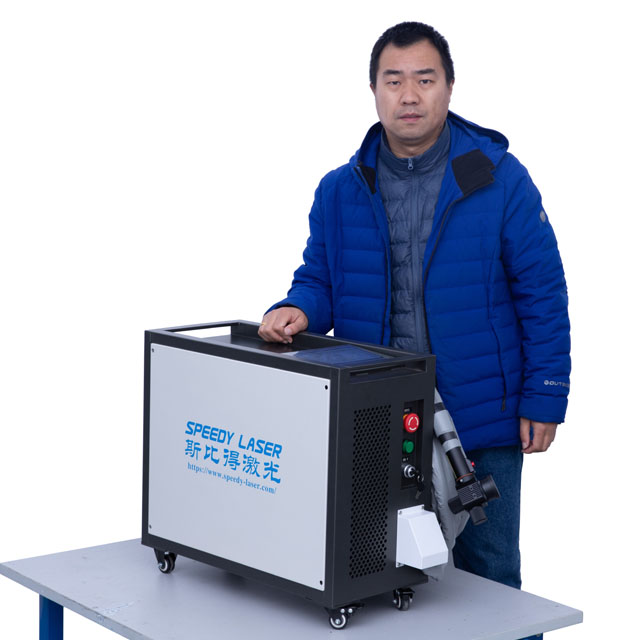
Footprint and ergonomics matter deeply for field service teams. Air-cooled units fit into compact flight cases. They often weigh under 50kg. One person can lift them into a service truck easily. Conversely, water-cooled units remain heavily cabinet-bound. They easily exceed 150kg. You typically need a forklift to move them safely across a busy warehouse.
Let us look at continuous run times closely. Water-cooled systems excel in 24/7 automated line integration. They handle relentless duty cycles without overheating. Air-cooled systems dominate batch processing. They work perfectly for maintenance shifts and remote field operations. They might require brief cooling periods during extreme, non-stop usage in hot environments.
Maintenance requirements define equipment longevity. Air-cooled systems require simple fan-filter replacements. You can swap a dirty filter in two minutes. Water-cooled machines carry complex mechanical risks. Algae growth can clog delicate coolant lines. Pump failures halt production completely. Coolant leaks can destroy expensive internal electronics permanently.
Consider environmental protection ratings carefully. High-quality systems carry IP54 or higher enclosures. This rating ensures robust protection against harmful dust ingress. It also prevents damage from splashing liquids. Meeting these strict industrial standards guarantees reliable operation in harsh manufacturing environments.
Cooling System Comparison Chart
Feature | Air-Cooled Systems | Water-Cooled Systems |
|---|---|---|
Mobility | High (Portable flight cases) | Low (Cabinet-bound) |
Weight | Typically under 50kg | Often exceeds 150kg |
Maintenance | Quick fan-filter replacement | Fluid checks, pump repairs |
Ideal Use Case | Field ops, batch processing | 24/7 automated production |
Thermal Limit | Ambient temps up to 40°C | Less affected by ambient heat |
The 100W to 300W range represents the absolute sweet spot for air cooling. A 200W laser cleaner provides an optimal balance for most facilities. You achieve 100% duty cycle reliability safely. It delivers highly effective contaminant removal for rust, oil, and heavy paint. It poses zero risk to delicate substrates. We see excellent results on thin aerospace components and sensitive historical stone restorations.
Understand the fundamental difference between pulse energy and average power. A lower wattage pulsed system often removes rust faster than a higher wattage continuous wave system. The short pulse creates a powerful mechanical shockwave. This shockwave shatters the rust layer efficiently. Continuous waves simply melt the rust, which requires vastly more energy and damages the underlying metal.
Evaluate high-wattage air-cooled systems skeptically. If you look at a 1500W+ unit, demand documented evidence. You must see its continuous run-time data before thermal safety shutdowns trigger. Physics dictates that higher continuous power generates massive heat. Air cooling struggles to dissipate this severe thermal load quickly.
Calculate your required wattage based on contaminant thickness and required processing speed. Never buy the highest wattage blindly. High continuous power can easily warp thin sheet metal. A high-quality laser cleaning machine matches power delivery directly to the specific application at hand.
Environmental constraints dictate deployment success. Do not deploy air-cooled systems in unventilated, high-temperature foundries. Ambient air cannot sufficiently cool the internal heat sinks if the room temperature exceeds 45°C. You will experience constant thermal throttling and interrupted cleaning cycles. Proper ventilation remains essential for sustained operation.
Laser ablation is never truly fume-free. You must use localized fume extraction (LEV) during operation. The laser turns solid rust and paint into airborne particulate. Fume extractors handle vaporized heavy metals safely. They capture toxic coatings before operators inhale them. Secondary safety protocols remain non-negotiable under OSHA guidelines.
Protect your focusing lens diligently. Replace protective windows regularly to prevent dust ingress. Dust will rapidly degrade any optical equipment. A dirty lens absorbs laser energy, heats up, and shatters instantly. Broken optics halt production and require expensive replacements.
Follow these exact steps for proper optics maintenance:
Inspect the exterior protective windows daily before initiating the laser.
Clean smudged lenses using specialized optical wipes and absolute ethanol.
Replace the protective cover immediately if you notice pitting or burn marks.
Keep the laser gun securely capped when not actively processing parts.
Store spare lenses in a dust-free, climate-controlled environment.
First, decide if you need a standalone handheld unit. Alternatively, you might require an OEM laser cleaner module. These specialized modules arrive ready for robotic cell integration. They feature dedicated I/O ports for seamless PLC communication. Automated integration demands highly stable hardware architectures.
Assess vendor trustworthiness by demanding component transparency. Ask them to disclose their internal laser source origin. Reliable, industry-standard brands include IPG, Raycus, JPT, and Max. You should also verify the scanning galvanometer brand. Cheap galvanometers drift over time and produce highly inconsistent cleaning patterns.
Never buy heavy equipment on specifications alone. Send proprietary application samples directly to the vendor. Provide metal coupons coated in your specific factory contaminants. Demand rigorous proof-of-concept testing. Review their parameter documentation thoroughly before signing purchase orders. A reputable manufacturer will gladly demonstrate their capabilities on your actual parts.
Air-cooled lasers represent the optimal choice for facilities prioritizing high mobility and low maintenance.
They excel in intermittent-to-moderate duty cycles rather than raw, 24/7 continuous high-wattage output.
Pulsed laser technology pairs flawlessly with air cooling to protect delicate underlying substrates.
Success requires verifying your ambient factory temperature limits before finalizing a purchase.
Actionable Next Step: Audit your target cleaning environment for ambient temperature and power availability today. Then, initiate a sample-testing phase with a transparent, engineering-focused equipment manufacturer.
A: Yes, if the wattage remains under 300W. A well-engineered 200W system can easily manage an 8-hour shift at a 100% duty cycle. However, high-power systems exceeding 1000W depend heavily on ambient temperatures. They will likely experience thermal throttling or safety shutdowns during continuous, extended use.
A: No, it does not. Pulsed lasers rely on a specific ablation threshold. The laser energy vaporizes surface contaminants like rust or paint. Once the beam hits the highly reflective bare metal, the energy dissipates harmlessly. This ensures the underlying substrate remains completely unaltered.
A: Your primary expenses include standard electricity usage, replacement protective lens covers, and HEPA filters for localized fume extraction. Because you eliminate bulky chillers, you completely avoid the recurring financial burdens of distilled water, antifreeze, and routine pump maintenance.
A: Absolutely. Handheld laser guns provide exceptional ergonomic advantages. Operators can easily manipulate the beam around curves, corners, and tight crevices. Furthermore, advanced software allows you to adjust the scanning width and focal depth to match complex surface profiles perfectly.