Views: 0 Author: Site Editor Publish Time: 2026-04-29 Origin: Site
Industrial surface preparation and cleaning operations require solutions that deliver consistent, high-quality results without environmental impact or substrate damage. A Laser Cleaning Machine provides non-contact cleaning capability that removes contaminants including rust, scale, paint, and coatings while preserving the underlying material surface.
Speedy Laser offers comprehensive laser cleaning solutions ranging from compact 100W systems for precision cleaning through high-power 3000W configurations for heavy industrial applications. Our equipment utilizes proven pulse laser technology combined with ergonomic designs that enable efficient operation across diverse cleaning requirements.
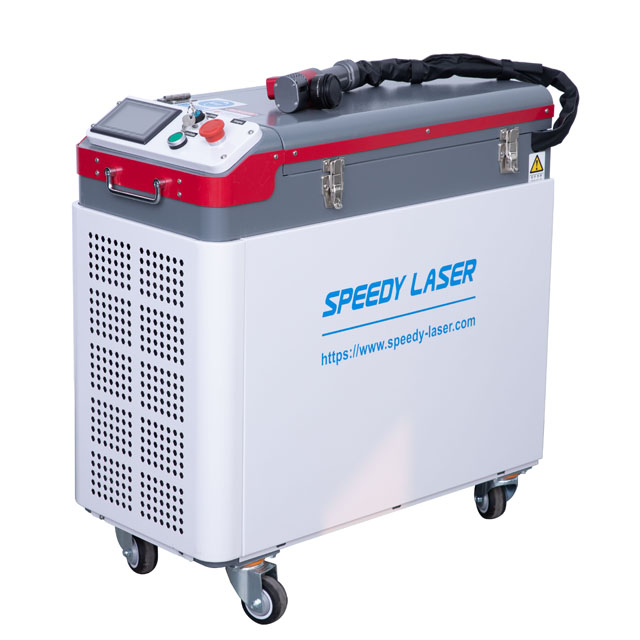
Laser Cleaning Machine systems utilize high-intensity laser pulses to vaporize or sublimate surface contaminants without damaging the underlying substrate material. The process operates through selective absorption where contaminants absorb laser energy while the base material reflects most incident energy.
The wavelength selection affects cleaning performance across different contaminant types. Standard 1064nm fiber laser sources effectively clean most metallic contaminants while pulse MOPA technology provides adjustable pulse characteristics enabling optimization for specialized cleaning applications.
The non-contact nature of laser cleaning eliminates mechanical stress, abrasion, and chemical exposure that can damage sensitive surfaces. This capability enables cleaning of precision components, delicate substrates, and applications requiring preservation of surface finish or dimensional tolerances.
Industrial laser cleaning equipment spans a range of power levels and configurations designed for specific application requirements. Understanding the available options enables appropriate equipment selection for intended cleaning applications.
Pulse laser cleaning systems utilize Q-switched or MOPA pulsed lasers to deliver high-peak-power pulses that effectively vaporize surface contaminants. The adjustable pulse parameters of MOPA technology enable optimization for different contaminant types and substrate materials while the compact, air-cooled design enables portable deployment.
Continuous wave (CW) laser cleaning systems provide consistent power delivery for high-throughput industrial cleaning applications. The higher average power capability suits applications requiring rapid processing of large surface areas while the robust industrial design supports continuous production operation.
Laser Cleaning Machine power levels determine cleaning speed and capability across contaminant types and surface areas. Understanding the relationship between power level and application enables appropriate equipment selection.
100W-300W systems suit precision cleaning applications including mold cleaning, electronics manufacturing, and delicate surface preparation. The controlled cleaning capability prevents substrate damage while effectively removing contaminants from sensitive surfaces.
500W-1000W power levels bridge precision and production cleaning applications, providing capability for larger surface areas while maintaining controlled cleaning for moderate contamination levels. This range suits general industrial cleaning, coating removal, and production preparation applications.
1500W-3000W high-power systems deliver the throughput necessary for heavy industrial cleaning applications. The high power enables rapid removal of thick rust, heavy scale, and industrial coatings while the controlled pulse parameters prevent substrate damage.
Laser cleaning equipment specifications enable evaluation of system capability against application requirements. Key parameters include average power, pulse energy, frequency range, and cleaning area coverage:
Specification | Precision Class | Production Class | Heavy Industrial |
|---|---|---|---|
Average Power | 100W-300W | 500W-1000W | 1500W-3000W |
Pulse Energy | 1.5-5mJ | 5-15mJ | 10-40mJ |
Pulse Width | 2-500ns | 2-500ns | 2-500ns |
Frequency Range | 1-4000kHz | 1-4000kHz | 1-2000kHz |
Cleaning Area | 10-100mm | 50-150mm | 100-300mm |
Cooling Method | Air Cooled | Air/Water | Water Cooled |
Weight (Gun) | 0.5-0.8kg | 0.8-1.5kg | 1.5-3kg |
Precision cleaning applications benefit from lower power systems that provide controlled, gentle cleaning suitable for sensitive substrates. Production cleaning applications require the balance of power and control provided by mid-range systems while heavy industrial cleaning demands the throughput of high-power configurations.
Laser cleaning technology serves diverse industrial applications where efficient, non-contact surface preparation improves quality, reduces cost, or enables processes impossible with traditional cleaning methods. The versatility of laser cleaning enables deployment across manufacturing, maintenance, and restoration applications.
Manufacturing applications utilize laser cleaning for surface preparation prior to coating, bonding, or welding operations. The consistent, residue-free cleaning improves coating adhesion, bond strength, and weld quality while eliminating chemical or abrasive cleaning steps.
Maintenance and repair operations benefit from portable laser cleaning capability for rust removal, coating preparation, and component restoration. The non-contact process preserves component geometry and dimensional accuracy while effectively restoring surfaces to usable condition.
Mold cleaning represents a high-value application for Laser Cleaning Machine technology. The ability to clean mold cavities without disassembly, without chemical agents, and without surface damage addresses critical manufacturing requirements for injection molding, die casting, and compression molding operations.
Thermal fatigue and polymer buildup accumulate on mold surfaces during production, affecting part quality and requiring periodic cleaning. Laser cleaning effectively removes polymer residues, oxide layers, and surface contamination without affecting the precision-machined mold surfaces.
The portable design of modern laser cleaning equipment enables in-place mold cleaning that eliminates disassembly and reassembly time. This capability significantly reduces cleaning-related downtime while improving mold maintenance productivity.
Industrial rust removal applications benefit from laser cleaning capability to remove corrosion products while preserving the underlying metal surface. The controlled laser energy vaporizes iron oxide compounds without attacking sound metal, enabling restoration of corroded components.
Heavy equipment maintenance, structural steel restoration, and marine applications utilize laser cleaning for rust removal where traditional methods including grinding, sandblasting, or chemical treatment present limitations. The non-contact process eliminates surface damage and contamination associated with abrasive methods.
The environmental advantages of laser rust removal eliminate hazardous waste disposal requirements associated with chemical treatments while avoiding the dust and debris generated by abrasive methods. This capability addresses growing environmental compliance requirements while improving worker safety.
Achieving optimal cleaning results requires understanding and optimization of laser parameters for specific contaminant and substrate combinations. Key parameters include pulse energy, frequency, scanning speed, and overlap factor.
Pulse energy determines the intensity of individual cleaning pulses, with higher energy enabling removal of thicker or more adherent contaminants. The adjustable pulse energy of MOPA technology enables fine control over cleaning aggressiveness.
Scanning speed and pulse overlap determine effective treatment intensity across the cleaned surface. Slower scanning with appropriate overlap increases cleaning effectiveness while faster scanning improves throughput for lighter contamination levels.
Different base materials exhibit varying responses to laser cleaning, requiring parameter adjustment to achieve optimal results. Understanding material-specific behavior enables efficient cleaning process development.
Steel and iron substrates clean effectively across wide parameter ranges, with laser energy selectively targeting oxide and contamination layers. The reflective properties of clean metal surfaces prevent substrate damage while contaminants readily absorb laser energy.
Aluminum surfaces require careful parameter control due to the material high thermal conductivity and reflectivity. Lower pulse energies and adjusted frequencies prevent thermal effects while effectively removing oxidation and contamination layers.
Stainless steel cleaning requires attention to maintaining surface finish while removing contamination. The controlled energy delivery of laser cleaning preserves the decorative or functional surface finish while effectively cleaning the surface.
Laser Cleaning Machine technology provides significant advantages compared to traditional cleaning methods including mechanical cleaning, chemical treatment, and sandblasting. Understanding these advantages enables appropriate method selection for specific applications.
Mechanical cleaning methods including grinding and wire brushing generate surface damage, produce inconsistent results, and require physical contact that limits access to complex geometries. Laser cleaning eliminates surface damage while reaching confined areas without mechanical access requirements.
Chemical cleaning methods generate hazardous waste requiring special handling and disposal while presenting worker safety risks. Laser cleaning eliminates chemical agents entirely, producing only vaporized contaminants that can be collected for disposal if required.
Sandblasting and abrasive cleaning methods damage underlying surfaces, require consumable media, and generate significant dust and debris. Laser cleaning preserves surface integrity while eliminating consumables and containing removed contamination.
When evaluating Laser Cleaning Machine options, the following comparison highlights key differentiators:
Feature | Speedy Laser | Competitor A | Competitor B |
|---|---|---|---|
Laser Source | JPT/Raycus/MAX | Standard Chinese | Mixed Quality |
Power Range | 100W-3000W | 100W-500W | 50W-200W |
MOPA Available | Yes | No | No |
Pulse Energy | Up to 40mJ | Up to 15mJ | Up to 8mJ |
Cleaning Speed | High | Medium | Low |
Warranty | 2 Years | 1 Year | 1 Year |
Speedy Laser comprehensive power range and adjustable parameters enable optimized solutions for diverse cleaning requirements.
The environmental advantages of laser cleaning extend beyond elimination of chemical agents and consumables. The energy efficiency of modern laser systems minimizes power consumption while the precision of laser targeting reduces energy waste.
Worker safety improves through elimination of chemical exposure risks, reduced noise levels compared to abrasive methods, and elimination of repetitive physical contact with cleaning tasks. The ergonomic design of modern laser cleaning equipment further reduces operator fatigue and injury risks.
Regulatory compliance simplifies through elimination of chemical storage, handling, and disposal requirements. The straightforward documentation of laser cleaning parameters supports quality assurance programs and regulatory compliance documentation.
Industrial laser cleaning applications often benefit from system integration that automates cleaning operations for consistent quality and improved productivity. Understanding integration options enables optimization of cleaning operations.
Manual laser cleaning with portable equipment suits maintenance applications, field work, and variable cleaning requirements. The lightweight, ergonomic design of modern cleaning equipment enables extended operation without excessive operator fatigue.
Automated cleaning cells incorporate laser cleaning heads with CNC positioning systems for consistent, programmed cleaning operations. The automated approach ensures uniform cleaning results while enabling higher throughput for production cleaning applications.
Robot integration extends automated cleaning capability to complex three-dimensional surfaces and variable part geometries. The adaptive capability of robotic systems enables cleaning of diverse parts through programming adjustments rather than physical tooling changes.
Consistent laser cleaning results require attention to process parameters and their impact on cleaning effectiveness and substrate preservation. Quality Laser Cleaning Machine systems incorporate monitoring and control features that support process optimization.
Visual inspection provides primary quality verification for cleaning operations, with trained operators assessing cleaning completeness and surface condition. The distinct appearance of laser-cleaned surfaces enables efficient inspection while revealing areas requiring additional treatment.
Surface analysis techniques including profilometry, gloss measurement, and microscopic examination provide quantitative quality data for process development and qualification. These techniques verify that cleaning processes achieve specified surface conditions without substrate damage.
A: Laser Cleaning Machine systems effectively remove rust, scale, paint, coatings, oil, grease, oxidation, mold release agents, and various organic and inorganic contaminants. The specific parameters require optimization based on contaminant type and substrate material.
A: When properly configured for specific substrates, laser cleaning removes contaminants without substrate damage. The selective absorption of laser energy by contaminants versus substrates enables controlled cleaning that preserves underlying material surfaces.
A: Rust removal typically requires mid-to-high power levels depending on rust thickness and severity. Light surface rust responds to 200W-500W systems while heavy rust and scale buildup benefits from 1000W+ power levels for efficient removal.
A: Laser cleaning eliminates surface damage associated with sandblasting while producing cleaner results without embedded abrasive media. The non-contact process reaches confined areas impossible with sandblasting while eliminating consumable media and associated waste.
A: Professional Laser Cleaning Machine systems require minimal maintenance including periodic inspection and cleaning of the laser optics. The solid-state design eliminates wearing components while automated monitoring alerts operators to conditions requiring attention.
A: Yes, laser cleaning effectively removes paint coatings from metal surfaces. The process strips paint layers without substrate damage while producing minimal hazardous waste compared to chemical paint stripping methods.
Speedy Laser laser cleaning solutions address industrial surface preparation requirements across manufacturing, maintenance, and restoration applications. Our applications team supports process development and parameter optimization to ensure successful cleaning results.