Views: 0 Author: Site Editor Publish Time: 2026-08-20 Origin: Site
Traditional arc welding processes like TIG and MIG face critical bottlenecks in modern manufacturing today. Shops struggle against skilled labor shortages, high secondary finishing costs, and severe thermal distortion on thin materials. You need better solutions to stay competitive. A Laser Welding Machine offers transformative speed and precision to overcome these exact hurdles. However, high capital expenditure and strict operational requirements mean it is not a universal fix for every fabrication shop.
Before committing capital, you must understand the true capabilities and practical limitations of this technology. We provide an unfiltered, engineering-led assessment of real-world advantages and hidden disadvantages. You will learn if a LASER WELDING MACHINE justifies the investment for your specific production line. We closely examine material shifts, processing bottlenecks, and strict safety compliances so you can make an informed, data-backed decision.
The Primary Advantage: Up to 4x–10x faster welding speeds with a drastically reduced Heat-Affected Zone (HAZ), eliminating post-weld grinding and straightening for thin sheet metals.
The Primary Disadvantage: Low tolerance for poor part fit-up; laser welding cannot easily "bridge gaps" like traditional MIG, requiring higher precision upstream in cutting and bending.
Cost vs. ROI: Initial equipment costs are significantly higher, but ROI is typically achieved within 6–12 months through labor savings, faster throughput, and reduced consumable usage.
Format Matters: Choosing between handheld, robotic, or tabletop systems depends entirely on production volume, part consistency, and safety compliance budgets.
Manufacturing environments are changing rapidly. Shop owners can no longer rely purely on traditional methods to meet aggressive production schedules. Evaluating a modern laser system is no longer a luxury; it is a strategic necessity. Several distinct market forces drive this urgent shift.
Labor Market Realities: The declining availability of master TIG welders is forcing shops to adapt. Finding and retaining skilled personnel is harder than ever. Technology must lower the skill barrier. Operators can master handheld laser systems in days rather than years. This enables you to deploy new hires into production much faster.
Production Bottlenecks: You must address the hidden costs of traditional welding. Post-weld processing creates massive bottlenecks. Tasks like grinding, polishing, and straightening warped parts often take longer than the weld itself. A high-quality laser weld frequently requires zero secondary finishing.
Material Shifts: Modern designs demand lighter, stronger materials. We see a growing use of aluminum, titanium, and ultra-thin stainless steel in manufacturing. These materials are notoriously difficult to weld. Conventional methods typically cause severe thermal distortion. Laser systems handle thin gauges effortlessly.
Switching to optical energy for joining metals introduces exceptional benefits. The physics behind focused light allow operators to achieve results impossible with electric arcs. We can measure these advantages directly in throughput and part quality.
Travel speed metrics heavily favor laser technology. Operators routinely see dramatic increases in linear inches welded per minute. For example, a 1500W Handheld Laser Welding Machine can outpace TIG by up to 10x on standard sheet metal applications. This rapid travel speed means you can process more parts per shift. Fast throughput directly lowers your variable cost per part.
Concentrated energy density is the core strength of this technology. The beam focuses intense heat into a microscopic spot. Lower overall heat input prevents metallurgical degradation across the broader part. You avoid warping, severe discoloration, and structural weakening. This minimal Heat-Affected Zone allows for immediate painting, plating, or final assembly.
Modern units offer incredible parameter versatility. You can easily adjust pulse frequency, power, and beam focus. This lets you achieve deep, narrow keyhole welds for maximum structural integrity. Alternatively, you can widen the beam for smooth conduction welds focused purely on aesthetics. You control exactly how the energy interacts with your material.
Traditional setups burn through consumables quickly. Tungsten electrodes, gas lenses, and massive spools of filler wire cost money. Autogenous laser welding requires negligible filler wire. It also eliminates the need for expensive grinding discs and flap wheels. Slashing consumable usage directly improves your bottom line.
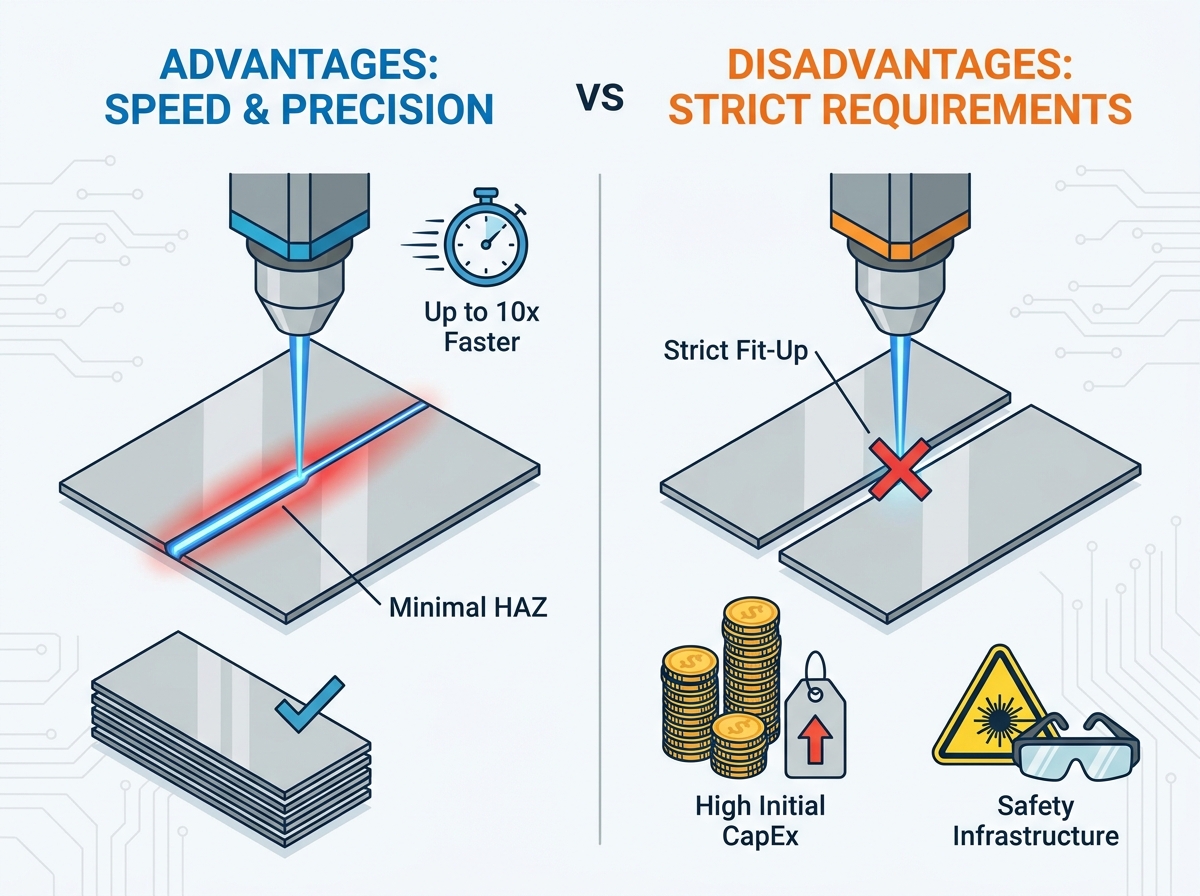
Lasers are not magic bullets. They demand specific environmental controls and highly precise part preparation. Ignoring these realities will quickly derail your implementation. You must evaluate these risks before committing to a purchase.
Strict Fit-Up Tolerances: A laser beam is incredibly narrow. If upstream press brake or laser cutting tolerances are loose, you will face major problems. If gaps exceed 0.5mm, the laser will simply pass through the gap. You cannot easily "weave" the torch or dump filler to fix bad fabrication. Precise fit-up is mandatory.
High Initial Capital Expenditure (CapEx): The upfront equipment cost presents a significant hurdle. These advanced systems are often 3x to 5x higher than high-end TIG or MIG power sources. You must have adequate capital and a clear path to fast payback.
Safety and Facility Requirements: Handheld units utilize Class 4 lasers. These require significant safety infrastructure. You must account for the hidden costs of building light-tight enclosures and interlock systems. Every person in the vicinity requires specialized laser safety glasses rated OD6 or higher.
Maintenance and Fragility: Industrial environments are harsh. Fiber optic cables, protective lenses, and complex laser heads are sensitive to dust, spatter, and dropping. Contaminated optics will instantly degrade weld quality. You must enforce strict cleanliness and handle the torch with care.
Selecting the proper system format dictates your eventual success. Each architecture serves a distinct manufacturing model. You must align the machine type with your specific production volume and part consistency.
Manual systems offer incredible flexibility. They are ideal for high-mix, low-volume (HMLV) environments and large, unwieldy parts. They are perfect for replacing manual TIG stations. Moving up in power changes your capabilities. A 2000W Handheld Laser Welding Machine offers deeper penetration for thicker materials, easily handling up to 6mm stainless steel. However, this higher power requires more careful heat management by the operator.
Automation maximizes throughput. A Robot Laser Welding Machine is ideal for high-volume, low-mix production. Think automotive components or mass appliance manufacturing. Evaluating this route requires caution. It demands flawless part repeatability. You face heavy upfront integration and programming costs. Once optimized, however, it yields the absolute lowest cost-per-part at scale.
Miniaturized precision requires stability. A Table Laser Welding Machine excels with medical devices, electronics, jewelry, and highly precise components. These units offer excellent safety compliance out-of-the-box. They usually feature Class 1 enclosures. The primary evaluation criteria is size; you are strictly limited by the physical dimensions of the internal work envelope.
Comparing these technologies directly clarifies the decision-making process. You must weigh aesthetics, speed, skill requirements, and structural capabilities.
We compare these directly on aesthetics, speed, and skill requirements. Laser easily wins on speed and operator skill level. You can train a new worker on a laser system quickly. TIG wins on upfront cost and gap-bridging capability. If your parts have poor fit-up, TIG remains highly relevant.
We compare these primarily on structural heavy-plate welding. MIG often remains superior for very thick, multi-pass structural steel. High wire deposition rates make MIG highly efficient for massive joints. Conversely, laser wins decisively on thin-to-medium gauge precision and low heat distortion.
Process Metric | TIG Welding | MIG Welding | Laser Welding |
|---|---|---|---|
Travel Speed | Slow | Medium / Fast | Extremely Fast |
Skill Requirement | Very High | Medium | Low |
Gap Bridging | Excellent | Excellent | Poor (requires precise fit-up) |
Heat Distortion | High | High | Very Low |
Calculating your break-even point is crucial. Provide your accounting team with a clear checklist. Weigh your current labor rate, grinding time, and consumable costs against the new laser CapEx, safety enclosure build-out, and ongoing maintenance. Fast processing and zero grinding often result in an ROI of under 12 months for busy shops.
The final verdict is clear. Advanced optical joining is an operational game-changer. It slashes production times and eliminates frustrating post-weld cleanups. However, this holds true only provided your upstream fabrication is precise enough to support it. Loose tolerances will quickly negate the benefits of expensive equipment.
Your actionable next step is straightforward. Before purchasing, request a comprehensive time-study and sample weld test from the manufacturer. Demand they use your actual production parts, not their highly optimized showroom coupons. Finally, assess your facility's readiness for strict laser safety compliance. Building proper enclosures takes time and budget.
A: Yes, if you process high volumes of thin sheet metal or spend more than 20% of production time on post-weld grinding. No, if you primarily weld thick structural steel with poor fit-up.
A: Only to a very limited extent. While some handheld models feature "wobble" heads or wire feeders to help bridge minor gaps (up to ~1mm), they cannot compensate for consistently poor fit-up.
A: Maintenance is surprisingly low compared to the moving parts of traditional wire feeders. The primary recurring costs are replacing protective cover lenses, nozzles, and the electricity to run the chiller.
A: Absolutely not. Handheld lasers emit Class 4 invisible radiation that can cause instant, permanent eye damage from scattered reflections. They must be operated inside designated, light-tight, interlocked enclosures.