Views: 0 Author: Site Editor Publish Time: 2026-01-26 Origin: Site
Are you wondering how thick a material a LASER WELDING MACHINE can handle? Whether you're in manufacturing, aerospace, or automotive industries, understanding this is crucial for choosing the right equipment.
In this article, we’ll explore the factors that affect the maximum thickness a laser welder can handle. You'll learn about the key variables, such as laser power, material type, and welding techniques, that influence welding depth. By the end, you'll know how to select the ideal LASER WELDING MACHINE for your specific welding needs.
Laser welding is a high-precision process that uses a focused laser beam to melt and fuse metals. The laser generates intense heat, which melts the metal, allowing it to be joined. The ability to control the intensity and focus of the laser allows the welder to perform delicate and high-precision welds on a variety of materials. Compared to traditional welding methods, laser welding offers more control over heat distribution, significantly reducing the risk of warping or other defects that could affect the welded material's structural integrity.
A LASER WELDING MACHINE typically consists of the following components:
● Laser Source: This provides the energy required to generate the laser beam. It is the core component, and the power level of the laser source (measured in watts) directly influences the thickness of materials that can be welded.
● Beam Delivery System: This system directs the laser beam to the workpiece. It includes mirrors and optical fibers, which focus the beam onto the metal.
● Control Unit: This component regulates various parameters such as power, speed, and laser beam focus, ensuring the weld meets the required specifications.
These components work together to ensure that the welding process is efficient and precise, even on delicate materials.
Laser welding offers several advantages over traditional methods:
● High Precision: Achieves fine, high-quality welds with minimal heat-affected zone (HAZ), making it ideal for components with tight tolerances.
● Speed: Laser welding is generally faster than traditional welding methods, especially when working with thinner materials.
● Minimal Distortion: Because laser welding uses focused energy, it results in minimal distortion of the material compared to conventional welding methods, making it ideal for applications where dimensional accuracy is critical.
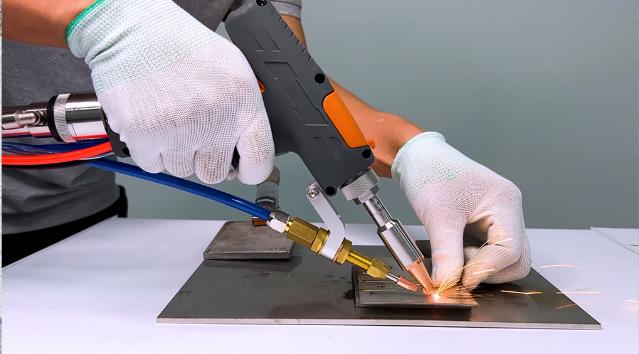
The power of the laser is the most critical factor influencing how thick a material a LASER WELDING MACHINE can handle. Higher power levels provide more energy for deeper penetration into thicker materials.
Here’s a general guide:
● 1 kW Laser: Best for thin metals, capable of welding materials up to 3mm thick.
● 3 kW Laser: Ideal for medium-thickness materials, capable of welding metals up to 8mm thick.
● 6 kW Laser: Suitable for thicker materials, capable of welding metals over 10mm.
Tip: Choose a laser welder based on the material's thickness and your specific production needs. Higher power is required for thicker materials but increases operational costs.
Different materials have varying properties that affect how they absorb laser energy. Metals such as steel and aluminum reflect and absorb laser energy differently. This affects the penetration depth and the laser power required for effective welding:
● Steel: Has good thermal conductivity and can absorb laser energy effectively, making it easier to weld at deeper penetration levels.
● Aluminum: Reflects more laser energy than steel, which means it requires more power to achieve similar penetration depths. This is why LASER WELDING MACHINES designed for aluminum often have higher power capacities.
● Copper and Brass: Copper and brass are more challenging to weld due to their high thermal conductivity, which dissipates heat quickly. These metals may require specialized settings to achieve effective welds.
In addition to power and material, the welding process itself influences the maximum thickness a laser welder can handle:
● Keyhole Welding: A technique that creates a deep, narrow weld pool, allowing the laser to penetrate thick materials more effectively. This technique is commonly used for welding metals thicker than 6mm.
● Conduction Welding: Typically used for thinner materials, this method involves the laser's heat being spread across a wider area, leading to shallow penetration. It is less effective on thicker materials, where deeper penetration is needed.
Steel is one of the most common materials welded using LASER WELDING MACHINES. Steel offers excellent heat conductivity, allowing laser welders to achieve deeper penetration with less power compared to other materials.
Laser Power | Maximum Thickness for Steel |
1 kW | 3mm |
2 kW | 6mm |
3 kW | 8mm |
A 3 kW laser can easily weld steel up to 8mm thick, making it ideal for applications like automotive and structural welding.
Aluminum and copper are more challenging to weld compared to steel. Aluminum reflects much of the laser energy, requiring high-powered LASER WELDING MACHINES to achieve effective welds.
Laser Power | Maximum Thickness for Aluminum |
1 kW | 2mm |
3 kW | 6mm |
The increased power requirements for aluminum make 3 kW or higher lasers the most effective for welding thicker aluminum parts. Copper, with its high thermal conductivity, also requires similar settings.
For very thick materials, a single pass may not be sufficient. Multi-pass welding involves making multiple welds over the same joint, allowing deeper penetration with each pass. This method is commonly used for welding metals thicker than 10mm, especially in high-strength applications like those in aerospace and heavy machinery.
The power level of a LASER WELDING MACHINE determines the maximum thickness it can effectively weld. Below is a quick reference chart:
Laser Power | Stainless steel | Carbon steel | Aluminum |
1.5KW | 3mm | 3mm | 2mm |
2KW | 4mm | 4mm | 3mm |
3KW | 6mm | 6mm | 4mm |
6KW | 10mm | 10mm | 6mm |
High-powered lasers, such as those in the 3 kW to 6 kW range, are required for applications in industries like aerospace, automotive, and shipbuilding. These industries often work with thick materials that demand higher precision and deeper penetration for strong, reliable welds.
Tip: For industrial applications, always consider the material's thickness and the weld strength required before selecting the appropriate laser welder.
Fiber lasers offer better efficiency and flexibility compared to CO2 lasers. While CO2 lasers are commonly used for cutting, fiber lasers are ideal for welding thicker metals due to their higher power and precision. Fiber lasers can handle materials up to 12mm thick, while CO2 lasers are typically effective for up to 6mm.
Handheld LASER WELDING MACHINES are designed for smaller, thinner materials, making them ideal for quick, on-site repairs or welding parts up to 6mm thick. These compact machines offer the same precision as larger systems but with the added benefit of portability.
For metals thicker than 10mm, hybrid welding systems, which combine laser welding with traditional methods like MIG or TIG welding, provide the best results. The addition of traditional welding techniques allows the laser to penetrate deeper and create stronger, more durable welds.
Keyhole welding is a technique that uses a highly focused laser beam to create a deep, narrow weld pool, allowing the laser to penetrate metals over 10mm thick. This method is essential when working with large, high-strength materials that require a deep fusion for structural integrity.
Combining laser welding with MIG or TIG welding can also help achieve the necessary penetration and strength for extremely thick materials. Hybrid welding is typically used for structural components in industries like aerospace, where strength and precision are paramount.
Hybrid Welding Method | Thickness Capability |
Laser + MIG | Up to 15mm |
Laser + TIG | Up to 12mm |
In conclusion, the thickness a LASER WELDING MACHINE can handle is influenced by factors like laser power, material type, and welding technique. Higher-powered lasers can weld thicker materials, while specialized techniques like keyhole welding allow deeper penetration. If you're looking for a reliable solution, Nanjing Speedy Laser Technology Co., Ltd. offers advanced laser welding machines that provide high precision, efficiency, and versatility. Their products are designed to meet the needs of various industries, ensuring strong, durable welds for both thin and thick materials. For more information, visit Nanjing Speedy Laser Technology Co., Ltd..
A: The thickness a LASER WELDING MACHINE can weld depends on its power. For example, a 1 kW laser can weld up to 3mm, while a 6 kW laser can handle over 10mm.
A: Different materials absorb laser energy differently. Steel absorbs more energy, allowing deeper penetration, while aluminum and copper reflect more energy, requiring higher power for thicker welds.
A: Select based on material thickness and strength needs. Higher-powered lasers are best for thicker materials, while lower-power machines are suited for thinner materials.
A: LASER WELDING MACHINES offer precision, speed, and minimal heat distortion, making them ideal for high-accuracy welding, especially in thin materials.
A: Yes, but it requires more power. Typically, a 3 kW laser is needed for welding aluminum up to 6mm thick.